Manual.ly Logo

JBL Aquaristic ProAquaTest Lab Bedienungsanleitung

0,0 · 0 Bewertungen

PDF-Handbuch · 65 Seiten

Deutsch

M: QW-35-FL
Seite

/ 65

Loading...
20bbaef5bdec311f8d8e156c4e1fe9d6e449 page 9
16 17
deciency. Iron and some other trace elements are only sta-
ble in water for a limited time, even if they are bound to so-
called chelators, as is usual in modern fertilisers. In addition
any tap water added is usually iron-free. Therefore, the iron
content needs to be monitored regularly with this test and re-
plenished if necessary. Cncentrations as low as 0.1–0.2 mg/l
are sufcient for good plant growth. In very densely planted
aquariums, values of up to 0.6 mg/l can also be useful. In
marine water, values of up to 0.05 mg/l are recommended.
Procedure:
1. Rinse both test vials several times with the water to be
tested.
2. Use the enclosed syringe to ll each of the test vials with
5 ml of sample water.
3. Add 5 drops of Fe reagent to one of the two test vials and
mix by swirling. Allow to stand for 10 minutes until the
colour has developed completely.
4. Place both test vials in the grey comparator block: Place
the vial with added reagent at the smooth end and the
vial with untreated sample water (blank sample) at the
notched end of the comparator block.
5. Place the comparator block with the two test vials on the
colour chart in such a way that the notch points to the
values and move it on the colour chart until the colour of
the sample mixed with reagents corresponds as closely
as possible to the colour under the blank sample.
6. Read the iron content in the notch of the comparator.
Note:If you decide to use the JBL PRO AQUATEST NH
4
at
the same time, make sure you don’t mix up the measuring
vessels of either set. Traces of the JBL PRO AQUATEST
NH
4
left inside the measuring vessel may result in too high
readings in the iron test.
Correcting deviating values:
Too low: Fertilise with ferrous fertilisers from the JBL ferti-
liser range (e.g. JBL Ferropol).
Too high: Carry out the corresponding partial water change.
JBL PRO AQUATEST K
Features: JBL PRO AQUATEST K is an easy-to-use turbid-
ity test for the routine monitoring of the potassium content in
fresh and marine water.
Why test? Potassium is one of the macroelements which is
very effectively absorbed within a few hours and temporarily
stored by plants in fresh water. Growing plants require more
potassium compared to other elements. As a result, potas-
sium concentrations can drop to a minimum range, causing
plant growth to stagnate, even if the aquarium water is ferti-
lised regularly. Potassium deciency initially leads to chloro-
tic spots on the edges of the leaf, which gradually increase
and then turn into grey-brown necroses. The leaves may
crinkle or curl. In Central European tap water, potassium is
usually a decient element compared to in natural biotopes
and this especially applies to calcium and magnesium con-
centrations. For good plant growth, the potassium content
needs to be at around 10 mg/l, in aquariums with high il-
lumination (e.g. in so-called scapes) up to 30 mg/l can be
useful. Higher potassium values in aquarium water encour-
age the growth of green thread algae. Potassium is present
in seawater in concentrations of about 380–400 mg/l, but is
only consumed in small quantities. Excessively high potas-
sium contents can be dangerous for sensitive animals such
as shrimps. The potassium content of the aquarium water
needs to be measured on a daily basis initially. This enables
the needs of the plants to be determined and the dosage of
the fertiliser can be carried out accordingly. Afterwards, rou-
tine measurements can be carried out after longer intervals.
Procedure:
Freshwater:
1. Rinse the measuring tube (plastic) and the tube (glass)
for the potassium content reading several times with the
water to be tested.
2. Using the syringe supplied, ll 15 ml of sample water into
the measuring tube.
3. Add 10 drops of reagent 1 and mix by swirling.
4. Add 1 large level measuring spoon (broad end of the
enclosed double-ended spoon) of reagent 2 and swivel
slightly for about 30 seconds until the powder has dis-
solved. The water becomes whitish and cloudy. Leave to
stand for 1 minute and then swirl slightly again.
5. Place the glass tube for reading the potassium content
reading on the cross of the colour card.
6. The following procedure should be carried out in bright,
diffuse light. Pour the´ turbid water from the measuring
tube into the reading tube until the turbidity means the
cross on the colour card is no longer visible from above.
7. The potassium content can now be read on the scale of
the tube (bottom of the meniscus).
Marine water:
1. Fill 10 ml sample water with distilled water to 300 ml.
2. Follow the same steps as for fresh water.
3. Multiply the test result by a factor of 30.
Correcting deviating values:
Too low: In freshwater aquariums fertilise with potassium-
containing fertilisers from the JBL ProScape range. We do
not recommend an additional dosage in marine water be-
cause potassium is toxic for various organisms.
Too high: Repeat the measurement after 24 hours. If the
value is still too high, carry out the corresponding partial
water change.
JBL PRO AQUATEST Cu
Features: JBL PRO AQUATEST Cu is an easy-to-use color-
imetric test to routinely determine the copper content in fresh
and marine water aquariums, and in garden ponds. A com-
pensation method developed by JBL allows reliable results
to be obtained even in slightly discoloured water (caused by
peat ltering or disease treatment etc.).
Why test? Copper is a heavy metal which is on the one
hand indispensable as a trace element for plant and animal
organisms. On the other hand it has a devastating effect
as a cell poison (cytotoxin) above a certain concentration.
Copper mainly reaches the aquarium in tap water, as cop-
per pipes were often used for water installation. If the water
remains in such pipes for a longer period of time, consid-
erable amounts of copper can dissolve. The water in the
pipe should therefore be drained before use. For the same
reason, do not use rainwater that has owed over copper
gutters. And make sure the tools you use when setting up
your aquarium or pond are copper-free. A controlled entry
of copper takes place through the application of medications
against parasitic sh diseases, as well as with some algae-
killing agents. The copper concentrations prescribed for this
can be tolerated by sh for a certain time while parasites,
etc., start dying off immediately.
Please note: Copper quickly forms water-insoluble com-
pounds which form deposits on the ground. The JBL PRO
AQUATEST Cu only detects copper dissolved in water.
Procedure:
1. Rinse both test vials several times with the water to be
tested.
2. Use the enclosed syringe to ll each of the test vials with
5 ml of sample water.
3. Add 5 drops of reagent 1 to one of the two test vials and
mix by swirling. Then add 5 drops of reagent 2 and mix
again. Allow to stand for 15 minutes until the full colouring
develops.
4. Place both test vials in the grey comparator block: Place
the vial with added reagent at the smooth end and the
vial with untreated sample water (blank sample) at the
notched end of the comparator block.
5. Place the comparator block with the two test vials on the
colour chart in such a way that the notch points to the
values and move it on the colour chart until the colour of
the sample mixed with reagents corresponds as closely
as possible to the colour under the blank sample.
6. Read the copper content in the notch of the comparator.
Correcting deviating values:
Too low: The value should always remain below the detec-
tion limit (except for some special treatments).
Too high: Regular use of JBL water conditioners, such as
JBL Biotopol or ltering with JBL’s high performance acti-
vated carbon. Water-insoluble copper compounds can only
be eliminated by removing the complete substrate.
JBL PRO AQUATEST O
2
Features: JBL PRO AQUATEST O
2
is an easy-to-use colori-
metric test for the routine monitoring of the oxygen content
in fresh and marine water aquariums, and in tap and garden
pond water, within a range of 1–10 mg/l (ppm).
Why test? All animals living in water need oxygen to
breathe. Even the „invisible helpers“ in aquariums and
ponds, the cleansing bacteria, are dependent on a suf-
cient oxygen content for the conversion of ammonium to
nitrate. The oxygen supply they need can be safeguarded
by adequate planting. In aquariums and ponds with little or
no planting and in marine aquariums, the oxygen content
always needs to be kept at the appropriate saturation value
with the help of technical equipment. The saturation value
depends on the water temperature (see table on last page).
Plants are able to exceed this saturation value through their
assimilation activity. In well planted aquariums and ponds,
for example, values can be found towards the end of the
lighting period, which are 1 to 2 mg/l higher than the satura-
tion value.
Procedure:
1. Rinse the measuring vessel several times with the water
to be tested.
2. Fill the measuring vessel to the brim with the water to be
tested by immersing it in water and place it on a water-
proof surface.
3. Add 6 drops of O
2
reagent 1 and 6 drops of O
2
reagent
2 slowly one after the other, until the measuring vessel
overows.
4. Avoiding bubble formation, close the measuring vessel
bubble-free with the enclosed cap and shake vigorously
for approx. 30 seconds.
5. Remove the cap from the measuring vessel and add 6
drops of O
2
Reagent 3.
6. Close the measuring vessel again (bubbles no longer
matter) and shake vigorously for approx. 30 seconds. Al-
low to stand for 10 minutes until the full colouring devel-
ops.
7. Move the measuring vessel back and forth approx. 3–5
cm above the white part of the colour chart and select the
colour with the best possible match.
8. Read the oxygen content off the relevant colour eld.
Correcting deviating values:
Too low: Put in more plants and/or improve care of exist-
ing plants, e.g. by installing a CO
2
supply unit (JBL ProFlora
CO
2
kit). Improve ventilation, e.g. with a JBL ProSilent air
pump and/or improve water movement on the surface with
ow pumps, protein skimmers (marine water) or in garden
ponds with stronger pumps (pond lters) in conjunction with
a waterfall or watercourse.
Too high: Not applicable.
JBL PRO AQUATEST CO
2
Direct
Features: JBL PRO AQUATEST Ca is an easy-to-use titra-
tion test to determine the carbon dioxide content of fresh-
water.
Why test? Carbon dioxide (CO
2
) is the most important plant
nutrient. The consumption of CO
2
differs from aquarium to
aquarium and depends, amongst other things, on the fol-
lowing factors: number and demands of plants, carbonate
hardness, water movement and light. Fertilisation with CO
2
is usually done with a CO
2
fertiliser system. In the aquarium
water, a CO
2
content between 15 and 30 mg / l is recom-
mended. This range is safe for sh and at the same time en-
sures luxuriant plant growth. 20–25 mg/l CO
2
has proven to
be ideal. In special aquariums with a large number of plants,
so-called scapes, higher values of up to 35 mg/l may be re-
quired. With this test you can determine the CO
2
content of
your aquarium water in mg/l and thus monitor the setting of
your CO
2
fertiliser system.
Please note: When fertilising with so-called liquid carbon,
fertiliser monitoring with JBL PRO AQUATEST CO
2
Direct is
not possible because these fertilisers do not contain CO
2
but
other carbon compounds.
Procedure:
1. Rinse the measuring vessel and syringe several times
with the water to be tested.
2. Using the syringe, insert 20 ml of bubble-free sample
water into the measuring tubes.
3. Place the measuring tube on both elds of the enclosed
colour chart.
4. Pour 5 drops of reagent 1 into the measuring tube on the
white eld and swirl it until it is mixed.
5. Add reagent 2 drop by drop. After each drop, swirl and
count the drops until a pink colour is obtained which re-
mains stable for 60 seconds and corresponds to the col-
our in the second measuring tube on the pink colour eld.
To compare the colours, look into the tubes from above.
6. The number of drops multiplied by 2 gives the carbon di-
oxide content in mg/l. Example: 10 drops of reagent 2 =
20 mg/l CO
2
.
Since other acids in the water impair the measurement, a
blank value must also be determined. To do this, take a wa-
ter sample of 100 ml and aerate it for 15 min using a JBL
ProSilent air pump with an air stone. Then determine the
blank value according to the instructions given above.
Result–blank value = actual carbon dioxide concentration
in mg/l.
Correcting deviating CO
2
values:
Too low: Add carbon dioxide to the aquarium using a JBL
ProFlora CO
2
fertiliser system.
Too high: Aerate the aquarium using a JBL ProSilent air
pump.
CO
2
table
Special feature: The CO
2
table enables you to determine
the carbon dioxide content through the carbonate hardness
(KH) and the pH value of the water. This method should only
be used if no pH-lowering substances, such as nitrate or
peat, are in the water.
Why test?
Carbon dioxide (CO
2
) is the most important plant nutrient.
The consumption of CO
2
differs from aquarium to aquarium
and depends, amongst other things, on the following factors:
number and demands of plants, carbonate hardness, water
movement and light. Fertilisation with CO
2
is usually done
en
en
en
en
en

Chatten Sie mit Ihrem JBL Aquaristic ProAquaTest Lab-Handbuch mithilfe von KI

Erhalten Sie sofortige KI-Antworten aus Ihrem JBL Aquaristic ProAquaTest Lab-Handbuch

Fragen Sie alles über JBL Aquaristic ProAquaTest Lab. Antworten stammen aus diesem Handbuch, mit den Seiten, auf denen sie basieren.

ProAquaTest Lab Wartungsplan

Täglich
Magnesiumgehalt im Süßwasseraquarium messen

Anfangs täglich messen, um den Pflanzenbedarf und die Dosierung des Düngers zu bestimmen. Danach auf längere Intervalle wechseln.

Täglich
Kaliumgehalt im Süßwasseraquarium messen

Anfangs täglich messen, um den Pflanzenbedarf und die Dosierung des Düngers zu bestimmen. Danach auf längere Intervalle wechseln.

M: qwen/qwen3.8-flash

Stellen Sie eine Frage

0/1000

Empfehlen Sie ProAquaTest Lab?

Ja Nein

Häufig gestellte Fragen

A

Gewährleisten Sie genaue Ergebnisse durch mehrfaches Spülen aller Gefäße mit Probenwasser vor dem Test. Halten Sie Tropfer vertikal, um Luftblasen zu vermeiden. Folgen Sie den spezifischen Wartezeiten für die Farbentwicklung. Vergleichen Sie Farben gegen die Karte auf einem weißen Hintergrund. Verwenden Sie die bereitgestellten Spritzen und Comparator-Blöcke für konsistente Volumina.

Ist diese Antwort hilfreich?

A

Schwankungen im pH-Wert können aquatische Organismen schädigen. Plötzliche Änderungen sind besonders stressreich. Verfärbtes Wasser kann das Ablesen stören, aber Kompensationsmethoden helfen. Messen Sie immer zur gleichen Tageszeit, da Licht CO2-Spiegel und pH beeinflusst. Vermeiden Sie Tests unmittelbar nach Zugabe von Chemikalien oder Futter.

Ist diese Antwort hilfreich?

A

Prüfen Sie kritische Parameter wie pH und Ammoniak regelmäßig, besonders in neuen Setup. Testen Sie Nährstoffe wie Nitrat und Phosphat monatlich, wenn das System stabil ist. Prüfen GH und KH wöchentlich, um Härteentwicklungen zu überwachen. Testen Sie Sauerstoffwerte, wenn Fische Anzeichen von Stress zeigen oder in stark besetzten Becken. Frequenz hängt von Besetzungsdichte und Beckengröße ab.

Ist diese Antwort hilfreich?

A

Ja, das Handbuch umfasst Süßwasseraquarien, Meerwasseraquarien und Gartenteiche. Spezifische Tests existieren für Koi-Teiche mit hoher Besetzungsdichte. Allgemeine Härte und pH-Tests gelten für die meisten Süßwasserumgebungen. CO2-Tests sind spezifisch für bepflanzte Aquarien mit aktivem Pflanzenwachstum.

Ist diese Antwort hilfreich?

A

Hoher Ammoniak zeigt ein biologisches Filterproblem an. Führen Sie sofort einen großen partikulären Wasserwechsel durch. Fügen Sie wohltuende Bakterien hinzu, um den Stickstoffzyklus wiederherzustellen. Prüfen Sie, ob vor kurzlich verwendete Medikamente wohltuende Bakterien geschädigt haben. Stellen Sie sicher, dass Fütterung reduziert wird, bis Spiegel sichere Grenzen zurückkehren. Überwachen Sie pH, da es Ammoniak-Toxizität beeinflusst.

Ist diese Antwort hilfreich?

A

Korrigieren Sie niedrige Kohlensäurehärte durch Zugabe von JBL-Wasserconditionern enthalten Hydrogencarbonat. Sie können auch Mineralsalzgemische verwenden, die für Aquarien bestimmt sind. Vermeiden Sie Wasserenthärtung, wenn sie bereits zu niedrig ist. Überwachen Sie sorgfältig nach Anpassung, um pH-Schwankungen zu verhindern. Testen Sie nach 24 Stunden erneut zur Bestätigung der Stabilität.

Ist diese Antwort hilfreich?

A

Lagern Sie Reagenzien trocken bei Raumtemperatur in ihrer Originalverpackung. Bewahren Sie sie fern von direkter Sonneneinstrahlung und Wärmequellen. Stellen Sie sicher, dass Tropfer außen trocken sind, bevor sie in Flaschen zurückgegeben werden. Mischen Sie keine Verschlüsse zwischen verschiedenen Testkits. Überprüfen Sie Verfallsdaten regelmäßig, da alte Reagenzien ungenau Ergebnisse geben können.

Ist diese Antwort hilfreich?

M: QW-35-FL

Vorteile und Nachteile

Vorteile

  • Umfassendes Sortiment an Tests, das alle wichtigen Parameter für diverse aquatische Einrichtungen einschließlich Süßwasser, Meerwasser und Gartenteiche abdeckt
  • Sophistische Kompensationstechnologie sorgt für zuverlässige Ergebnisse selbst in durch Torffilterung oder Behandlungen verfärbtem Wasser
  • Detaillierte Verfahren minimieren Benutzerfehler und beinhalten visuelle Hilfen wie Farbkarten für einfache Interpretation von Messungen
  • Reagenzien sind stabil und wirksam bei korrekter Lagerung, ermöglicht langfristige konsistente Überwachung der Wasserchemie
  • Spezielle Werkzeuge vereinfachen den Testprozess und machen ihn zugänglich für Anfänger während er präzise für Experten bleibt
VS

Nachteile

  • Einige Tests erfordern Farbablesung innerhalb von 15 Minuten, um Genauigkeit zu gewährleisten, bevor die Lösungsfarbe sich ändert
  • Benutzer müssen sicherstellen, dass Testgefäße nicht zwischen verschiedenen Testkits gemischt werden, um Kreuzkontamination von Proben zu vermeiden
  • Präzision hängt von sorgfältigem Tropfenzählen und Halten der Tropfer vertikal ab, erfordert Aufmerksamkeit auf Details
  • Korrektur von hohen Giftwerten erfordert oft sofortige große Volumenwasserwechsel, die störend sein können
  • Reagenzien können mit der Zeit abgebaut werden, wenn nicht in Originalverpackung fern von Hitze und Feuchtigkeit gelagert
M: QW-35-FL

Produkt Spezifikation

Bereich

Wasserwerte

Typ

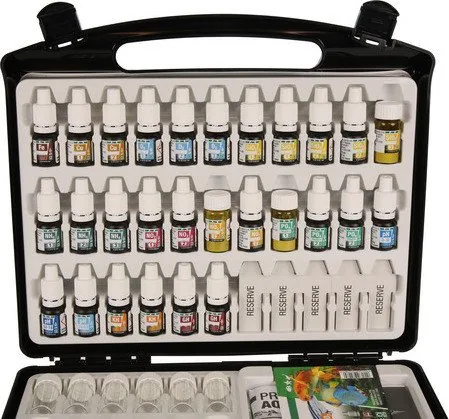
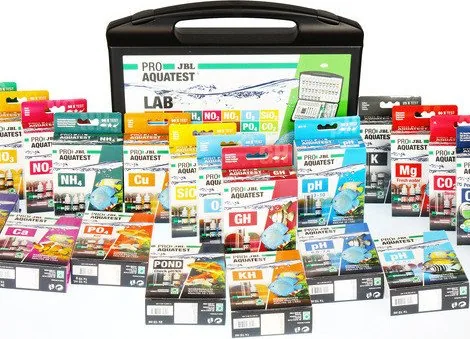
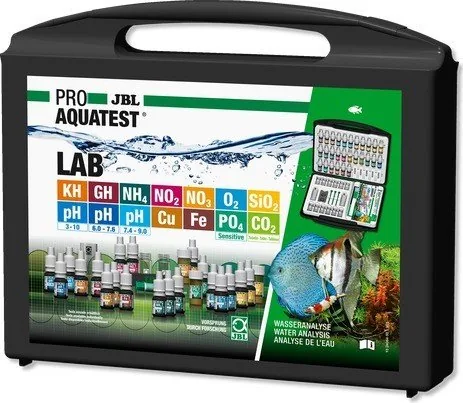
Wassertest (pH (3 Bereiche), Karbonathärte, Gesamthärte, Phosphat, Nitrit, Nitrat, Eisen, Kupfer, Silikat, Sauerstoff, Ammonium, Ammoniak, CO2 Indirekt), Testset

Abmessungen

38,20x8,51x31,80cm (BxHxT)

Gewicht

1,27 kg

M: QW-35-FL

Produkt Beschreibung

Meisterung der Aquarienwasserchemie

Die Aufrechterhaltung eines gesunden aquatischen Umfelds erfordert eine präzise Überwachung der Wasserchemie, um das Wohlbefinden aller darin lebenden Organismen sicherzustellen. Das JBL Pro AquaTest Lab Testkasten Handbuch bietet wesentliche Anleitung für Liebhaber, die Exzellenz in ihren Aquarieneinrichtungen fordern, um den besten Zustand zu erhalten. Diese umfassende Sammlung stellt sicher, dass Ihre Fische und Pflanzen in optimalen Bedingungen gedeihen, indem sie detaillierte Anweisungen für verschiedene heutige Analysemethoden bereitstellt.

Wesentliche Testmethoden für Klarheit

Wasserqualität bestimmt den Erfolg jedes Aquariums unabhängig von den spezifischen Arten, die Sie halten. Egal ob Sie Süßwassertiere oder Meerwasserlebewesen oder Gartenteich-Kois halten, verschiedene Parameter benötigen spezifische Aufmerksamkeit für Stabilität. Das Handbuch beschreibt sophistische Titriermethoden und Farbmessmethoden, die für Genauigkeit und Benutzerfreundlichkeit für jeden bestimmt sind. Titriertests wie KH und GH verwenden präzise Tropfenzahlen, um Härtegrade effektiv über die Zeit zu bestimmen. Farbmetrische Tests wie pH und essentielle Nährstoffe verlassen sich auf Farbkarten für klare und lesbare Ergebnisse für schnelle Überprüfungen. Jeder Test enthält Schritt-für-Schritt-Verfahren, um Benutzerfehler während des Wasserproben Tests zu minimieren. Das System kompensiert effektiv Wasserverfärbung verursacht durch Torffilterung oder Behandlung, sorgt für Zuverlässigkeit selbst bei schwierigen Bedingungen.

Wichtige Parameter für die Gesundheit

Das Verständnis Ihres Wasserprofils ist entscheidend, um gefährliche Schwankungen zu verhindern, die empfindlichen Kreaturen schaden. Härtetests wie Pro AQUATEST GH und KH verhindern gefährliche pH-Schwankungen, die empfindliche Kreaturen erheblich schädigen. pH-Werte zwischen spezifischen Bereichen passen verschiedenen Arten von saurem Süßwasser bis zu alkalischen Meerwasserbecken perfekt. Nährstofftests überwachen komplexe Stickstoffzyklen wie Ammoniak, Nitrit und Nitrat, um die Systemfunktion genau zu verfolgen. Phosphat- und Silikatspiegel helfen, hartnäckige Algenblüten zu verhindern, die Ihr Becken ersticken und Fische töten können. Spurenelemente wie Eisen und Kupfer sind wichtig für Wachstum, müssen aber streng kontrolliert werden, um Toxizitätsrisiken zu vermeiden. Sauerstoffwerte sorgen für Lebensunterstützung für Fische und Bakterien, während CO2-Düngung üppiges Pflanzenwachstum in bepflanzten Becken fördert.

Wartung und Korrekturen für Stabilität

Die Aufrechterhaltung stabiler Parameter vermeidet Stress und Krankheitsausbrüche in Ihrem Ökosystem auf lange Sicht. Wenn Werte von den empfohlenen Bereichen abweichen, bietet das Handbuch spezifische Korrekturschritte zur Anpassung zur Behebung von Problemen. Zu wenig Härte erfordert das Hinzufügen von Mineralsalzen, während Überschuss die Verwendung von Umkehrosmosefilterung vorschlägt, um sie zu reduzieren. Nährstoffmangel benötigt spezifische Düngemittel aus der ProScape-Reihe, die online leicht erhältlich sind. Hohe Giftwerte erfordern sofortige Wasserwechsel oder Einführung von biologischen Filtern, um das Gleichgewicht schnell wiederherzustellen. Lageranweisungen stellen sicher, dass Reagenzien weiterhin effektiv für zukünftige Testperioden sind, bevor sie ablaufen. Tropfer müssen vertikal gehalten werden, um Luftblasen während der Abgabe von Reagenzien zu verhindern. Regelmäßige Überwachung verhindert unerwartete Überraschungen in Ihrer Wartungsroutine für Ihre Becken. Durch Befolgen der JBL Pro AquaTest Lab Testkasten Handbuch Anleitung können Aquarienbesitzer Wasserklaarheit und Stabilität für ihre Haustiere erreichen.

M: QW-35-FL

© Copyright 2026 Manual.ly